1. The Evolution of AI Service Desks
Legacy customer service automation relied on brittle rule-based decision trees, requiring exhaustive intent categorization that disintegrated whenever end users phrased queries outside rigid regex patterns. With modern large language models, specifically OpenAI's GPT-4o mini and flagship GPT-4o, customer interaction systems can preserve semantic context across long multi-turn sessions while retaining strict corporate tone constraints.
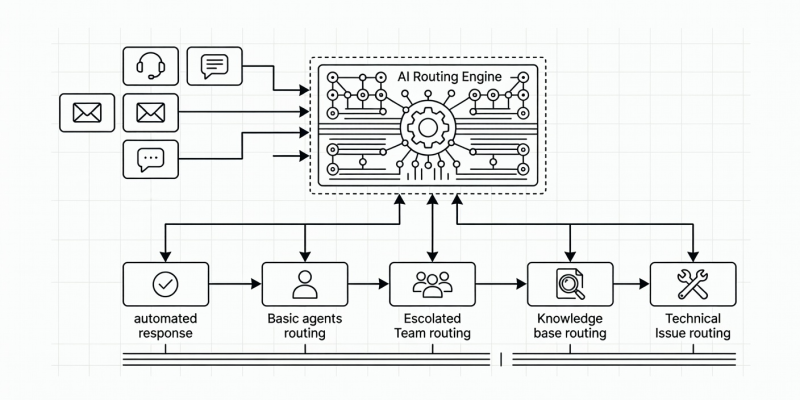
When architecting an enterprise support agent, the model should not act as an unconstrained chatbot. Instead, it must serve as an intelligent orchestrator situated between the user interface, customer relationship management (CRM) database records, and verifiable internal knowledge resources.
2. Model Comparison: GPT-4o vs. GPT-4o mini for Tier-1 Triage
Selecting the appropriate model tier determines both fiscal sustainability and conversational latency. For first-line support desks receiving thousands of tickets daily, latency under 500 milliseconds is paramount to prevent drop-off.
| Operational Metric | GPT-4o mini | GPT-4o |
|---|---|---|
| Primary Role | Tier-1 Intent Triage & FAQ Resolution | Complex Disputes & Multimodal Ticket Diagnosis |
| Context Window | 128,000 tokens | 128,000 tokens |
| Relative Input Cost | Low baseline (optimized for high volume) | Standard flagship enterprise rate |
| Time to First Token | Sub-250ms (ultra responsive) | Moderate (~400-600ms) |
| Multimodal Support | Text & Vision Inputs | Native Omni Text, Vision & Audio In/Out |
3. Implementation Architecture: Prompt Caching and State Handling
Customer support prompts generally carry heavy static instructions: company identity policies, refund rules, escalation criteria, and catalog taxonomies. Under OpenAI's prompt caching architecture, repeated input prefixes that exceed 1,024 tokens automatically qualify for substantial cost discounts and lower processing times.
To achieve this, the system prompt must remain strictly immutable across sessions, placing variable customer history at the trailing tail of the payload:
4. Trade-Off Analysis: Autonomous Resolution vs. Human Escalation
Operational Advantages
- Instant 24/7/365 first response time across all global timezones.
- Consistent compliance with published corporate terms and policy statements.
- Automated bilingual translation handling multi-language customers natively.
- Direct integration into ticketing webhooks for automated order tagging.
Operational Risks
- Hallucination risk on unindexed policy exceptions without strict RAG bounds.
- Customer sentiment friction when an agent fails to recognize frustration early.
- Token expenditure spikes during non-convergent, circular conversational loops.
- Need for continuous monitoring of boundary edge cases and prompt injection.
5. Deterministic Guardrails & Safety Policy
Enterprise customer support must incorporate a definitive exit condition: whenever customer sentiment indicators dip below a defined threshold or high-risk legal terms are invoked, the model must execute a deterministic tool call transfer to a live representative. By strictly constraining model outputs via JSON schema definitions, enterprise architects prevent unpredictable conversational escalation.